
(Trans)National European Theatre: audiovisual tools and simultaneous interpreting for the internationalisation of theatre production and consumption
01.1.2023-30.11.2026
European Cooperation Project
Cooperation partner:
Avignon Université
Théatre AU Chapeau Rouge, Avignon
Associazione Culturale PACTA Arsenale dei Teatri, Milan
IULM: Università di comunicazione e lingue, Milan
Funded by European Union
About the project
(Trans)National European Theatre: audiovisual tools and simultaneous interpreting for the internationalisation of theatre production and consumption (TraNET) is an innovative Creative Europe project dedicated to transforming the landscape of European theatre by fostering new forms of international engagement and audience participation.
TraNET is reshaping the way we experience international theatre across Europe. Imagine three theatres—one in Avignon, one in Milan, and one in Berlin—all coming together for a single festival that transcends borders. Now, imagine being part of an audience that stretches across countries, experiencing live performances in three different languages — English, Italian, and German—at the same time. This is the heart of TraNET.
At its core, TraNET is about connecting people through theatre, no matter where they are. We’re blending the magic of live performance with cutting-edge technology to create a truly shared European experience. During our two-year transnational theatre festival, audiences in different countries will watch the same shows simultaneously, some seated in front of actors performing live on stage, others as part of a theatre audience connected via live streaming. The performances will be enhanced with multilingual live surtitling, suitable for people with hearing impairments, making sure that no matter what language the play is in, everyone can follow along and be part of the same story and emotion.
This isn’t just about watching a show—it’s about being part of a single, unified audience, spread across borders but connected through a shared live experience. After each performance, the conversation continues with post-show debates streamed live, allowing audiences from different countries to engage in discussion together. We’re breaking down language barriers, opening up new ways to enjoy theatre, and making sure that theatre can be a truly European experience.
Our festival features three exciting productions. We’re reimagining national classics from France, Italy, and Germany, focusing on important themes like democracy, equality, and gender equality . These plays will inspire and challenge audiences, showing how theatre can address the issues that matter most today.
TraNET is more than just a theatre project—it’s a new way of bringing people together through culture, language, and technology. Whether you’re sitting in a theatre in Avignon, Milan, or Berlin, you’ll be part of something bigger: a single, united audience, sharing the power of theatre across Europe.
Further information: https://tra-net.eu
First Year

The inclusive Festival CLASHING CLASSICS. Multilingualism on Stage
Dates in Berlin: 27.02.2025-06.03.2025, Theater im Delphi
Program:
Fear eats the Soul by Rainer Werner Fassbinder, multicultural city e.V., Berlin (more here)
27.02.2025, 19.30
Followed by a transnational audience discussion with the audience in Avignon and Milan via live stream with simultaneous translation.
28.02.2025, 11.00
School performance
01.03.2025, 19.30
02.03.2024, 15.00
Family performance
The Rules of the Game by Luigi Pirandello, PACTA. dei Teatri, Milan (more here)
03.03.2025, 19.30
Followed by a transnational audience discussion with the audience in Avignon and Milan via live stream with simultaneous translation.
Slave Island by Pierre Carlet de Chamblain de Marivaux, Au-delà du plateau / Les Rencontres du Chapeau Rouge/ Curtain Call, Avignon (more here)
06.03.2025, 19.30
Followed by a transnational audience discussion with the audience in Avignon and Milan via live stream with simultaneous translation.
In the first year of the biennial TraNET Festival, three timeless European classics are being reimagined for the modern stage by theatre companies in Milan, Avignon, and Berlin. These aren’t just revivals—they’re bold, fresh takes on the works that have shaped European theatre, seen through the lens of today’s world, exploring contemporary urgencies.
• In Milan, Pacta dei Teatri will present Luigi Pirandello’s The Rules of the Game, directed by Paolo Bignamini. This gripping drama about identity, deception, and human nature gets a contemporary twist that promises to challenge and provoke.
• In Avignon, Les Rencontres du Chapeau Rouge will produce Marivaux’s The Island of Slaves, directed by Helen Landau. This exploration of power and inequality will be given a sharp new edge, speaking to today’s struggles for justice and equality.
• In Berlin, multicultural city e.V will bring to life Rainer Werner Fassbinder’s Fear Eats the Soul, under the direction of Monika Dobrowlańska. This poignant story about love, prejudice, and loneliness will resonate with audiences now more than ever.
And here’s where it gets truly groundbreaking: these three productions won’t just be confined to their home stages. Thanks to TraNET’s innovative approach, all three plays will be live-streamed simultaneously across Europe. With real-time multilingual surtitling, the spectators seated in the stalls of a theatre in Milan, Avignon, or Berlin , will be part of one connected audience, sharing in the same stories while enjoying the sound and prosody of the performances intheir original languages.
The CLASHING CLASSICS Festival isn’t just a series of plays—it’s a celebration of Europe’s common cultural heritage, a showcase of the power of theatre to unite us across borders while exploring shared topics, and a glimpse into the future of live performance. Join us for this one-of-a-kind journey through language, culture, and the timeless art of storytelling.
New Publication: TRANET Project
We are excited to announce the latest publication of our TRANET Project! In parallel with the online performances of the first edition of the TRANET festival, we present our new theater educational resource:
This multilingual material has been developed to promote the diversity of languages and cultures in theater education. It offers practical approaches and creative ideas that assist both educators and learners in experiencing and discovering the beauty of theater in various languages.
Second Year
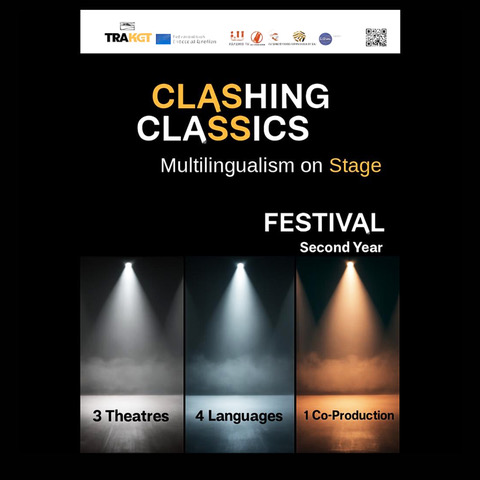
TraNET Festival “Clashing Classics” Second Edition
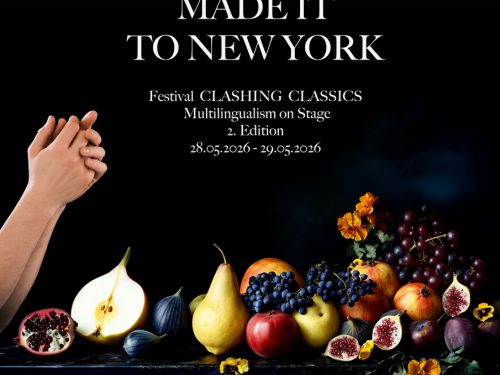
Teiresias never made it to New York
A multilingual and multisite performance
Co-production by: Association au Chapeau Rouge (Avignon-France), PACTA. dei Teatri (Milan-Italy), multicultural city e.V. (Berlin-Germany)
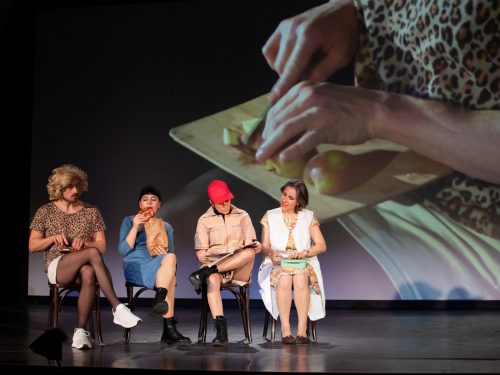
The second edition of the festival Clashing Classics presents the performance Teiresias never made it to New York. It is conceived as one single story unfolding simultaneously in three theatres. Rather than three independent productions, the work is a shared dramaturgy, a unified narrative that exists across distance. At its centre stands Teiresias, the mythic seer who has lived as both man and woman, who has “seen everything” yet remains condemned to incomprehension.
Teiresias becomes the connecting thread between the three cities: a single consciousness divided into three bodies, three languages, three spaces and three different times. Through live dialogue, visual echoes and shared timing, the three stages interact continuously thanks to the connection through live streaming. This experimental performance unifies the physical presence of the actors with the virtual presence of the actors acting on distant stages.
The three languages (French, Italian and German) underline the difference and the distance to build a new language: the theatre’s one. The result is not three plays but one living performance that expands beyond its physical limits to become a network of presences and languages unfolding at the same time in three spaces. Teiresias embodies our fragmented contemporary condition multiple, displaced, yet striving for unity.
The character of Teiresias is freely inspired by the homonymous character of the Waste Land by T.S. Eliot realizing an allusive atmosphere. The play’s dramaturgy is based on three interpretations of Teiresias’ character and developed from different languages and different cultures from which it could be created three different performances.
THE TRANSNATIONAL EXPERIENCE
The performance Teiresias never made it to New York is built on an integrated audiovisual system connecting the three theatres in real time. Each stage hosts live performers, some projections showing the other venues and multilingual surtitles for immediate comprehension. An interactive holographic projection introduces a poetic layer where images, objects and presences from distant stages appear and vanish.
This combination of live action, projection and holographic illusion creates a hybrid scenography in which physical and virtual bodies coexist. Sound and light are synchronized across the three locations, while minor resynchronizations are embraced as expressions of distance. Far from being decorative, technology functions as a dramaturgical device, transforming separation into connection and enabling one collective performance shared across borders.
Further information here.